
 SAKIGAKE管理人
 Transforming Disaster Prevention from “Ideals” into “Implementation”:SAKIGAKE JAPAN’s Business Strategy
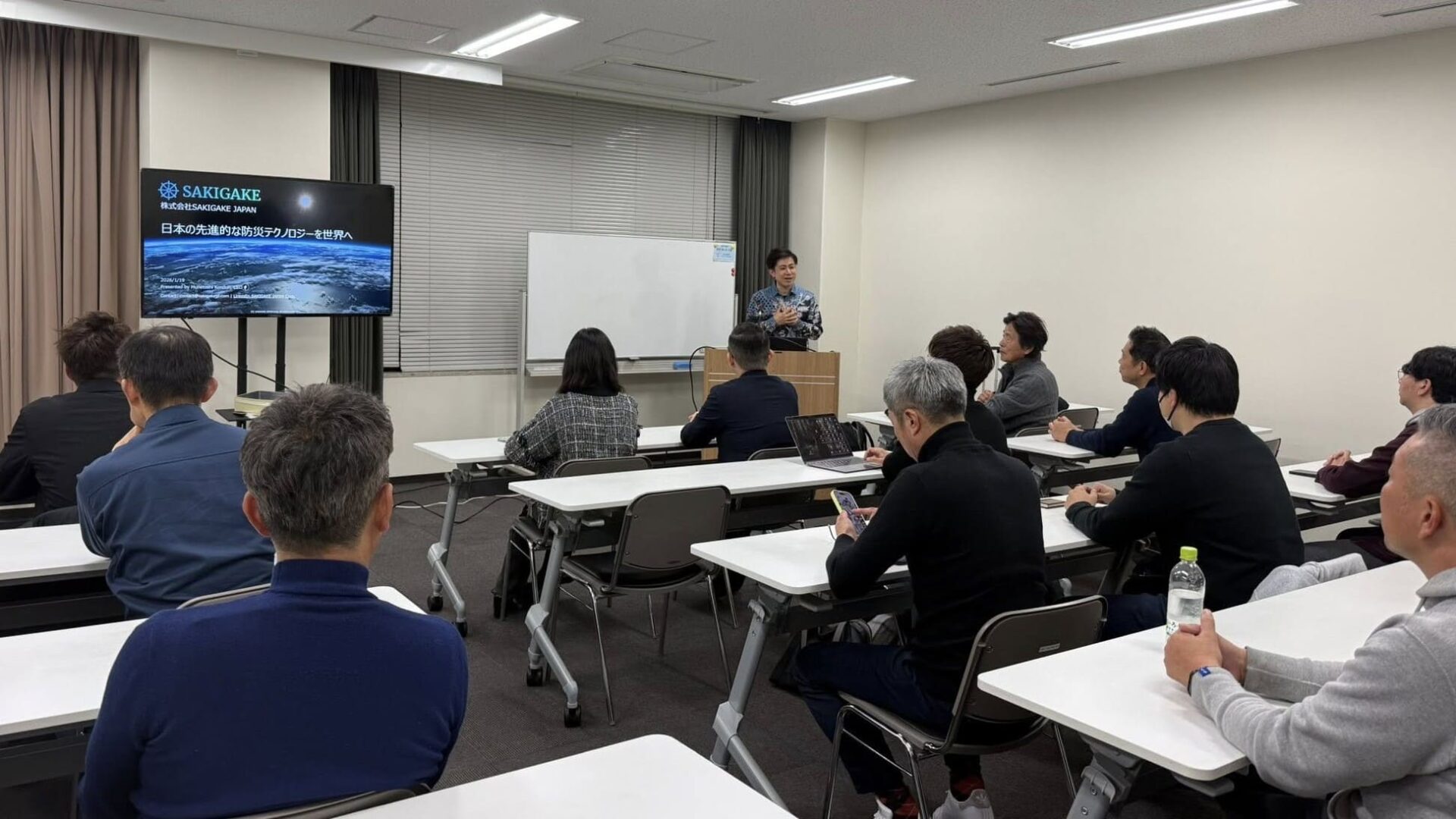
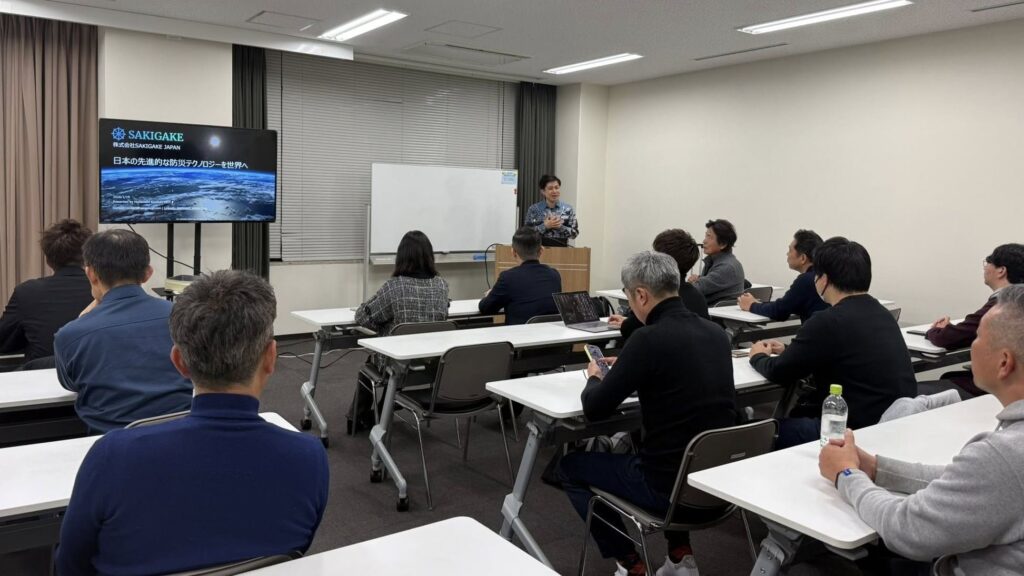
On January 30, 2026, at the regular meeting of WAOJE Fukuoka held at the Fukuoka Chamber of Commerce and Industry, Mr. Munetoshi Kondo, CEO of SAKIGAKE JAPAN, delivered a lecture on the theme of disaster prevention business strategy.
In this session, Mr. Kondo systematically shared SAKIGAKE JAPAN’s direction, beginning with the background of the company’s founding and its management philosophy, followed by an overview of the disaster prevention market, the concept of dual use (everyday use × emergency use), concrete projects underway both in Japan and overseas, and future initiatives focused on international expansion and standardization.
What Is WAOJE
WAOJE (World Association of Overseas Japanese Entrepreneurs) is a global network of Japanese entrepreneurs and business leaders operating overseas. With chapters in more than 40 countries and regions worldwide, WAOJE provides a platform where executives active on the front lines of international business can share knowledge and experience beyond national borders.
What distinguishes WAOJE is that it is not merely a networking or social organization. Instead, it places strong emphasis on:
- Sharing insights based on real-world experience in overseas markets
- Deep understanding of business environments, regulations, and risks in each country
- Mutual support and development of the next generation of entrepreneurs
In global business, it is essential not only to share success stories but also to openly discuss failures and trial-and-error experiences. WAOJE serves as a vital hub where such practical management knowledge can be exchanged openly among peers.
For more details, please refer to the following article:


The Role and Characteristics of WAOJE Fukuoka
The venue for this lecture, WAOJE Fukuoka, is a regional chapter composed mainly of entrepreneurs and executives based in Kyushu and the Fukuoka area. Thanks to its geographical proximity to Asia and a well-developed startup support ecosystem, Fukuoka has been increasing its presence as a hub connecting Japan and overseas markets.
Within WAOJE Fukuoka, discussions actively focus on topics such as:
- Business strategies aimed at overseas expansion
- Perspectives on the Global South and emerging markets
- Connecting regional companies with international business opportunities
The regular meeting went beyond simple case studies. Discussions delved deeply into decision-making processes, including why certain markets were chosen and how challenges were overcome, making the dialogue both practical and highly substantive.
Viewing Disaster Prevention as a “Socially Implemented System”
At the core of SAKIGAKE JAPAN’s business philosophy is the belief that disaster prevention should not be limited to “emergency-only responses” or awareness-raising activities. Disasters are not unexpected events that might occur someday—they are realities that must be assumed and planned for in advance when designing society and infrastructure.
For this reason, SAKIGAKE JAPAN positions the following not as isolated measures, but as continuously functioning systems embedded in society:
- Disaster response
- Business continuity planning (BCP)
- Regional and urban resilience
During the lecture, Mr. Kondo explained that the disaster prevention field was chosen because it uniquely satisfies three conditions simultaneously: personal interest, social contribution, and business viability. Moreover, as climate change progresses, demand for disaster prevention solutions is expected to grow steadily.
Dual Use as a Consistent Design Philosophy
A central theme of the lecture was the concept of dual use. Disaster prevention products and systems often face challenges because they are designed exclusively for emergencies:
- They are rarely used in normal times
- Investment decisions are postponed
- They are not properly operated when disasters occur
To address this, SAKIGAKE JAPAN redefines disaster prevention as infrastructure that is used in everyday life.
Examples include:
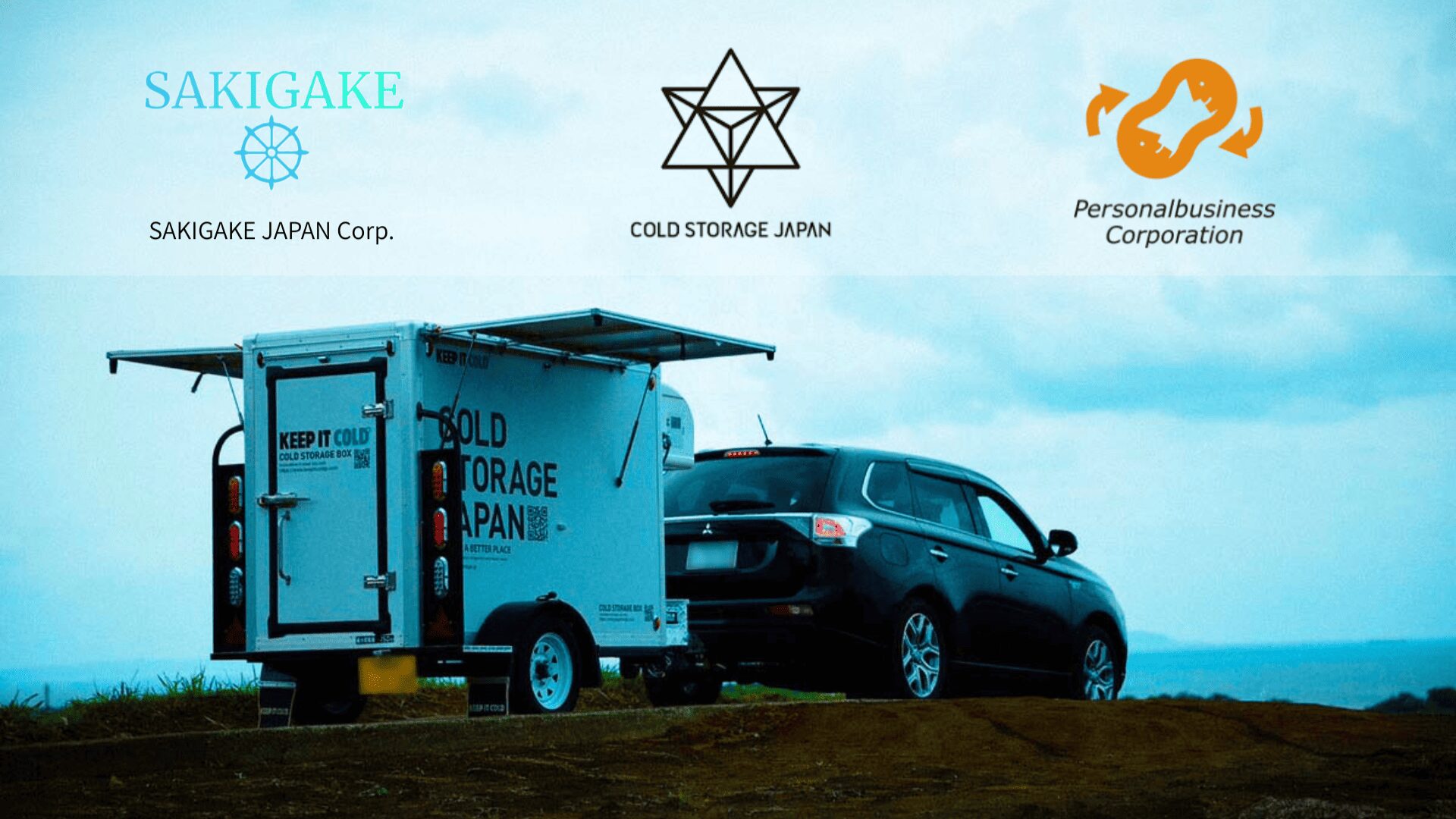
- Solar-compatible towable cold storage units
→ Used not only during disasters, but also in medical care, logistics, outdoor events, and fisheries - Photoluminescent signage
→ Provides evacuation guidance during blackouts while also serving as everyday lighting alternatives and contributing to landscape design - Seismic reinforcement coatings
→ Enhance disaster resilience while also improving building durability and asset value
These are not standalone products; they are connected by a single philosophy that eliminates the boundary between normal times and emergencies.
Enabling Japanese Disaster Prevention Technologies to Function Globally
The lecture also introduced initiatives underway in countries such as Indonesia, Saudi Arabia, Thailand, and Vietnam. From its founding, SAKIGAKE JAPAN has placed strong emphasis on international expansion for clear reasons:
- Climate change–related disasters transcend national borders
- Japan possesses world-class operational expertise in disaster response
- Yet, this value has not been sufficiently delivered overseas
Rather than exporting Japanese technologies as-is, SAKIGAKE JAPAN prioritizes redesigning them to fit local regulations, cultures, and infrastructure conditions, ensuring they are truly usable on-site.
For example, in Indonesia, the company is advancing a cold-chain development project that aims to simultaneously reduce post-harvest losses and improve fishermen’s income—demonstrating a model that balances disaster resilience with economic sustainability.
For further details:
The Next Phase: Standardization and Human Resource Development
One major challenge in disaster response is dependence on individuals. When response quality varies depending on who is present, scalability and reproducibility become impossible.
Through joint research with the University of Tokyo, SAKIGAKE JAPAN is working on:
- Phase-based classification of disaster response
- Matrix-based definition of roles and actions
- Practical standardization applicable in real operations
As part of this effort, the company is designing a Disaster Management Specialist, which visualizes on-site response capabilities—not just knowledge—and enables third-party evaluation. This system is being developed with both domestic and international use in mind.
Building Disaster Prevention into a “Foundational Industry” Through Co-Creation
The lecture also addressed co-creation initiatives with corporate partners, including Panasonic.
SAKIGAKE JAPAN aims to transform disaster prevention and resilience from a temporary social issue into a sustainable foundational industry and market. To achieve this, the company emphasizes:
- Integrated solutions combining hardware and software
- Designs that are used in everyday life
- Frameworks that allow governments, companies, and communities to communicate using a shared language
Value will be proven not through theory, but through implementation.
Closing
From its founding to the present, SAKIGAKE JAPAN has consistently prioritized building trust and professional credibility. Participation in accelerator programs, invitations to international forums, and collaborations with government agencies and universities are outcomes of that approach.
Rather than merely talking about disaster prevention, SAKIGAKE JAPAN focuses on making it function.
Rather than staying behind desks, the team goes to real sites and accumulates real-world implementation.
This lecture served as an opportunity to share both the company’s current position and its future direction. SAKIGAKE JAPAN will continue working to implement disaster prevention and resilience as systems that truly function within society.