
 SAKIGAKE管理人
 Introduction — From “Cost” to “Value” in Disaster Prevention
“Investing in disaster prevention is not a cost, but a value.”
This idea is now being questioned around the world.
The global disaster prevention systems market is projected to reach approximately USD 20.2 billion (roughly 30 trillion yen) in 2025, continuing to expand at an annual growth rate of 7–8%. The Asia-Pacific region in particular has become one of the fastest-growing markets. At the same time, however, disaster prevention business faces structural challenges: the difficulty of monetization and a lack of funding on the demand side mean that investment in disaster prevention and resilience tends to be perceived as a cost rather than as an investment contributing to long-term value creation.
The situation is no different in Japan. While demand for disaster prevention information systems and services has traditionally been driven by the public sector, in recent years there has been a growing trend of private companies proactively adopting weather information services and safety confirmation systems as part of their BCP (Business Continuity Planning) and employee safety initiatives. Nevertheless, the transformation of this market is still underway.
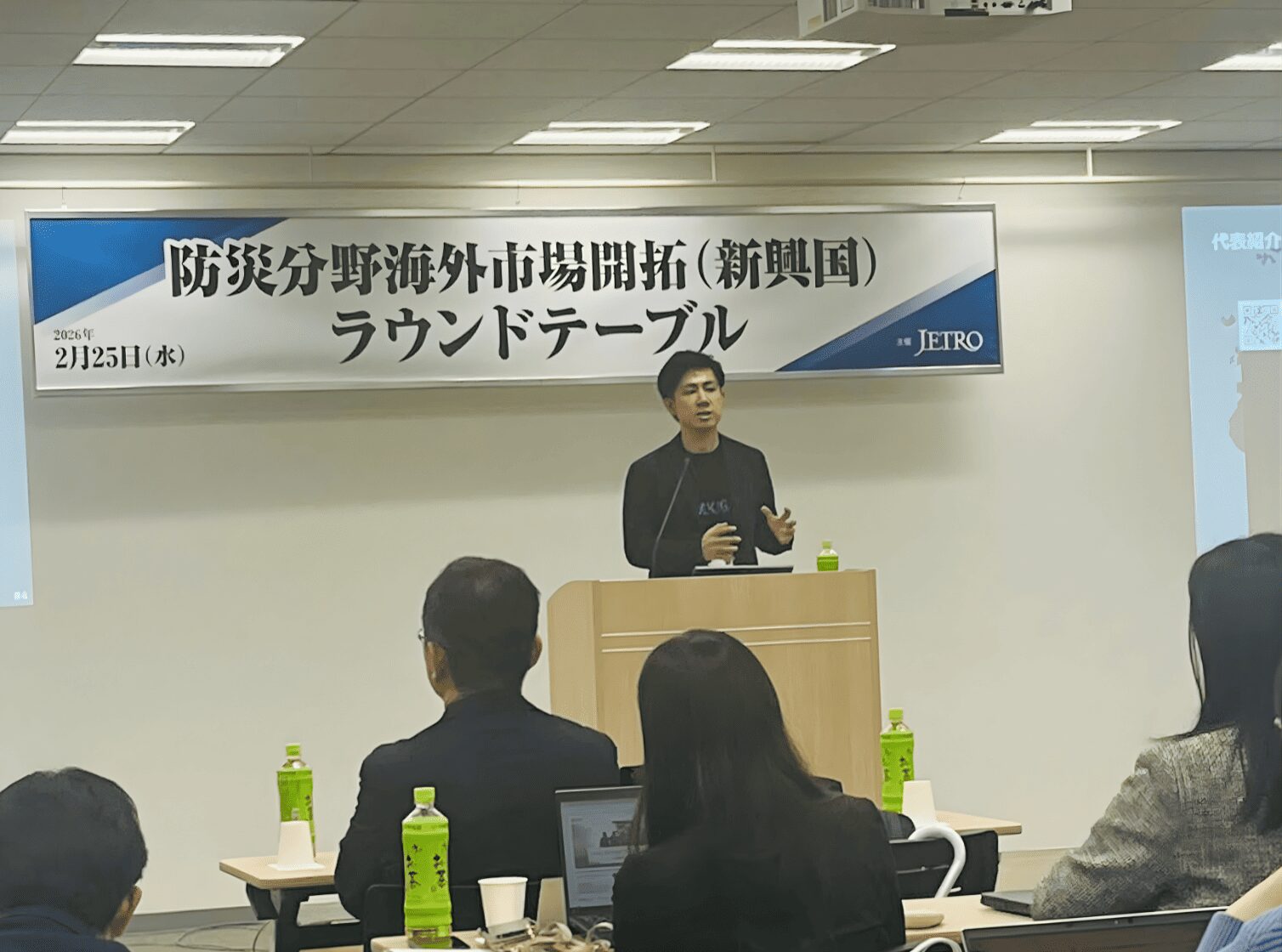
It was to break through this situation that JETRO (Japan External Trade Organization) organized this roundtable. SAKIGAKE JAPAN Corp. was given the opportunity to participate as a buyer of disaster prevention-related products.
Event Overview — JETRO’s Push for Private-Sector Market Development in Disaster Prevention
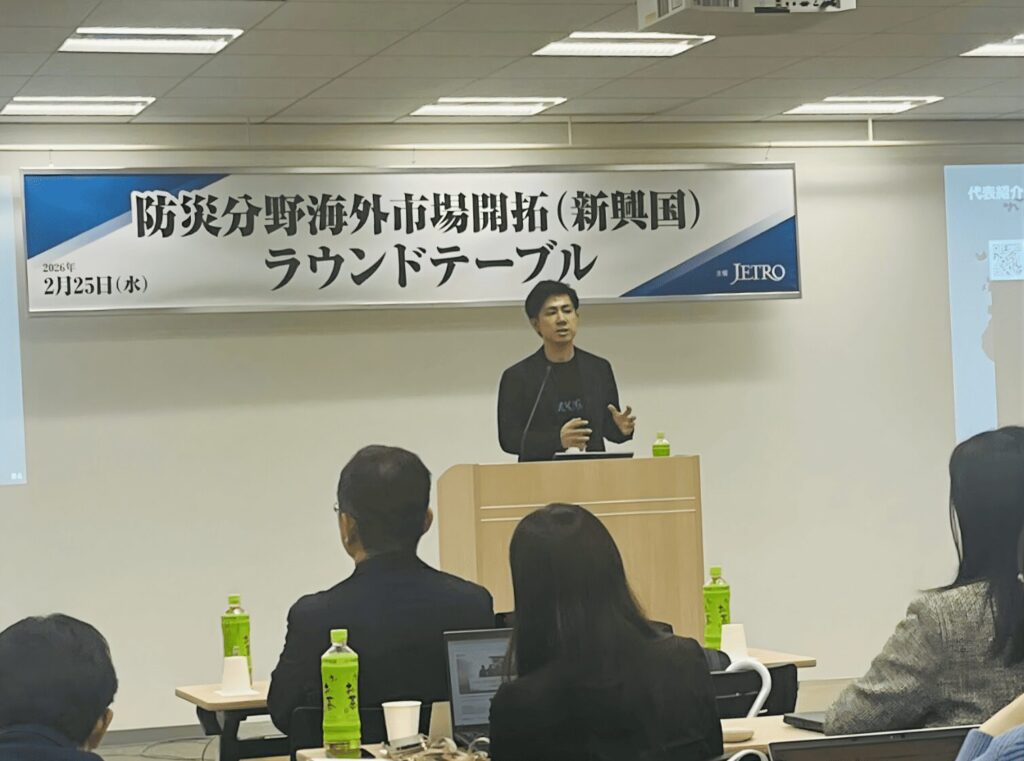
This event was a mutual pitch event involving both suppliers and buyers in the disaster prevention sector, targeting emerging countries and regions. In recent years, as export interest in the disaster prevention industry has grown even at the level of local government, the need to deepen understanding of local markets and to build business networks leading to future deals has increased significantly. While overseas expansion in the disaster prevention sector has been primarily driven by public-sector demand, Japan’s excellent products and technologies hold the potential to be exported to meet private-sector demand in disaster-affected countries and regions. The event aimed to deepen understanding of private-sector business opportunities and export feasibility, while also providing opportunities for networking and relationship-building toward future market development.
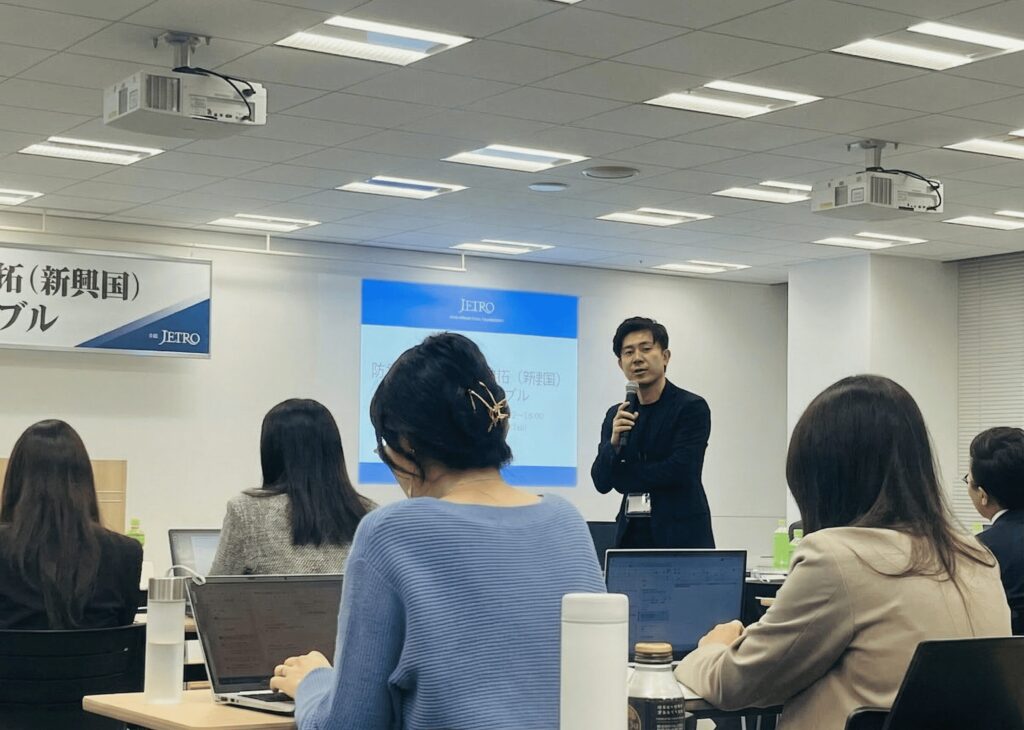
Details were as follows. On the day, more than 100 attendees — exceeding initial expectations — gathered at the venue.
▼ Roundtable for Overseas Market Development in the Disaster Prevention Sector (Emerging Countries)
https://www.jetro.go.jp/events/oda/8a6db9c30e31f560.html
▼ Date & Time Wednesday, February 25, 2026, 13:00–18:00
▼ Venue JETRO Headquarters, 5F JETRO Hall (ARK Mori Building, 1-12-32 Akasaka, Minato-ku)
▼ Program
- Keynote lecture: “The Current State of Japan’s Disaster Prevention Industry’s Overseas Expansion” by Dr. Satoshi Nishikawa, JICA International Cooperation Expert (Comprehensive Disaster Prevention)
- Case studies from pioneering local governments and organizations
- Pitches from disaster prevention product buyers (including SAKIGAKE JAPAN, 3 companies in total)
- Pitches from disaster prevention product suppliers (approx. 8 companies)
- Networking and exchange session among participants
▼ Organizer JETRO (Japan External Trade Organization)
Presentation Theme ① — How to Expand Japan’s Disaster Prevention into Overseas Markets
Japan is one of the world’s most disaster-prone countries. At the same time, through the accumulation of experience, it has also cultivated the world’s most sophisticated disaster prevention technologies, systems, and culture.
Japan has a track record of leading global discussions on disaster prevention, including the “Sendai Framework for Disaster Risk Reduction” (2015), and the concept of “BOSAI” (disaster prevention) originating from Japan is steadily gaining international recognition. On the technological front, disaster prevention technology now encompasses a wide range of innovations — from AI-based disaster prediction and drone-assisted rescue operations to real-time data collection via IoT devices — and has advanced rapidly, particularly with the spread of smartphones and the evolution of IoT and AI technologies since the 2000s.
However, technological capability and market development capability are two different things. For overseas expansion, it is essential to design a business model that answers “who to deliver to, what to deliver, and how to deliver it.” In developing countries in particular, where funding shortages are a prominent challenge, it is important not only to propose outright product and service sales, but also to develop business models that generate revenue through leasing and O&M (operation and maintenance) services, as well as to foster businesses that are built with overseas markets in mind from the outset.
Drawing on our domestic track record in disaster prevention consulting, BCP planning support, disaster prevention products, and emergency response solutions, SAKIGAKE JAPAN entered the roundtable discussions with the conviction that unlocking and creating value from private-sector demand for disaster prevention in Asian and emerging markets is the next frontier.
Presentation Theme ② — How to Expand the Public-Sector-Driven Disaster Prevention Field into Private Markets
Both in Japan and overseas, the greatest barrier to disaster prevention business is the structure of dependence on public-sector demand.
According to mid-range market size projections, public-sector demand in Japan’s domestic market for disaster prevention information systems and services is estimated at 169.1 billion yen in FY2025 — the largest segment, accounting for approximately 80% of the entire market. This structure means that decision-making on disaster prevention investment is concentrated on the government side, creating an environment in which it is difficult for private companies to develop a cycle of voluntary investment in disaster prevention.
Because disaster prevention solutions are rarely used during normal times and ROI (return on investment) is difficult to visualize, there is a tendency for procurement decisions to be deferred at both local governments and private companies. As a result, there is a growing number of cases in which disaster prevention solutions are utilized even in normal times by integrating them with daily operations such as stockpile management, disaster drill attendance management, and infrastructure inspection. The key to moving the private market lies not in the idea that products “can also be used in normal times,” but in the shift to making them something that is “used starting from normal times.”
▼ For more information on Phase Free, please see here:


This concept aligns precisely with the “Phase Free” approach that SAKIGAKE JAPAN has been advocating. Rather than treating disaster prevention as a special response only triggered when a disaster occurs, we believe that designing it as a continuous system embedded in everyday business activities is the path to unlocking the value of disaster prevention in the private market.
Presentation Theme ③ — What Does Sustainable Disaster Prevention Business Look Like?
The primary reason why investment in disaster prevention has been perceived as a “cost” is that its return manifests as “not having needed it (= having remained safe),” making it difficult to visualize.
However, from a different perspective, investment in disaster prevention reliably generates returns. Keeping business operations running, protecting employees, maintaining supply chains, and remaining a trusted partner for clients — all of these are management-level values created by disaster prevention investment.
Four converging factors — the increase in natural disasters due to climate change, the expansion of risk in densely populated urban areas, technological advances in AI, IoT, and big data analytics, and the growing emphasis on supply chain risk management driven by heightened BCP awareness among companies — are bringing the disaster prevention market into a phase of global demand expansion.
Sustainable disaster prevention business is not simply about selling disaster prevention products. It means becoming a partner that strengthens the resilience of companies, communities, and society as a whole, and continuing to provide support while making that value visible and quantifiable. SAKIGAKE JAPAN is committed to advancing the “value creation” of disaster prevention both domestically and internationally, as an organization dedicated to fulfilling that role.
Insights Gained and Outlook for the Future
With initiatives such as the Cabinet Office launching its “Survey and Demonstration Project on Overseas Expansion of the Disaster Prevention Industry” in FY Reiwa 7 (2025), momentum is steadily building on both public and private fronts toward the international expansion of Japan’s disaster prevention technologies.
Building on the knowledge, networks, and vision gained through this JETRO roundtable, SAKIGAKE JAPAN will continue to advance the “value creation” of disaster prevention both in Japan and abroad. Through the provision of corporate disaster prevention consulting, BCP planning, disaster drills, and emergency response solutions, we will deliver the power of disaster prevention cultivated in Japan to every place that needs it.
We extend our heartfelt gratitude to everyone at JETRO, and to all those who participated. Thank you for the many meaningful connections.
▶ Inquiries regarding corporate disaster prevention consulting, BCP planning, and disaster prevention products: Contact Us