
 SAKIGAKE管理人
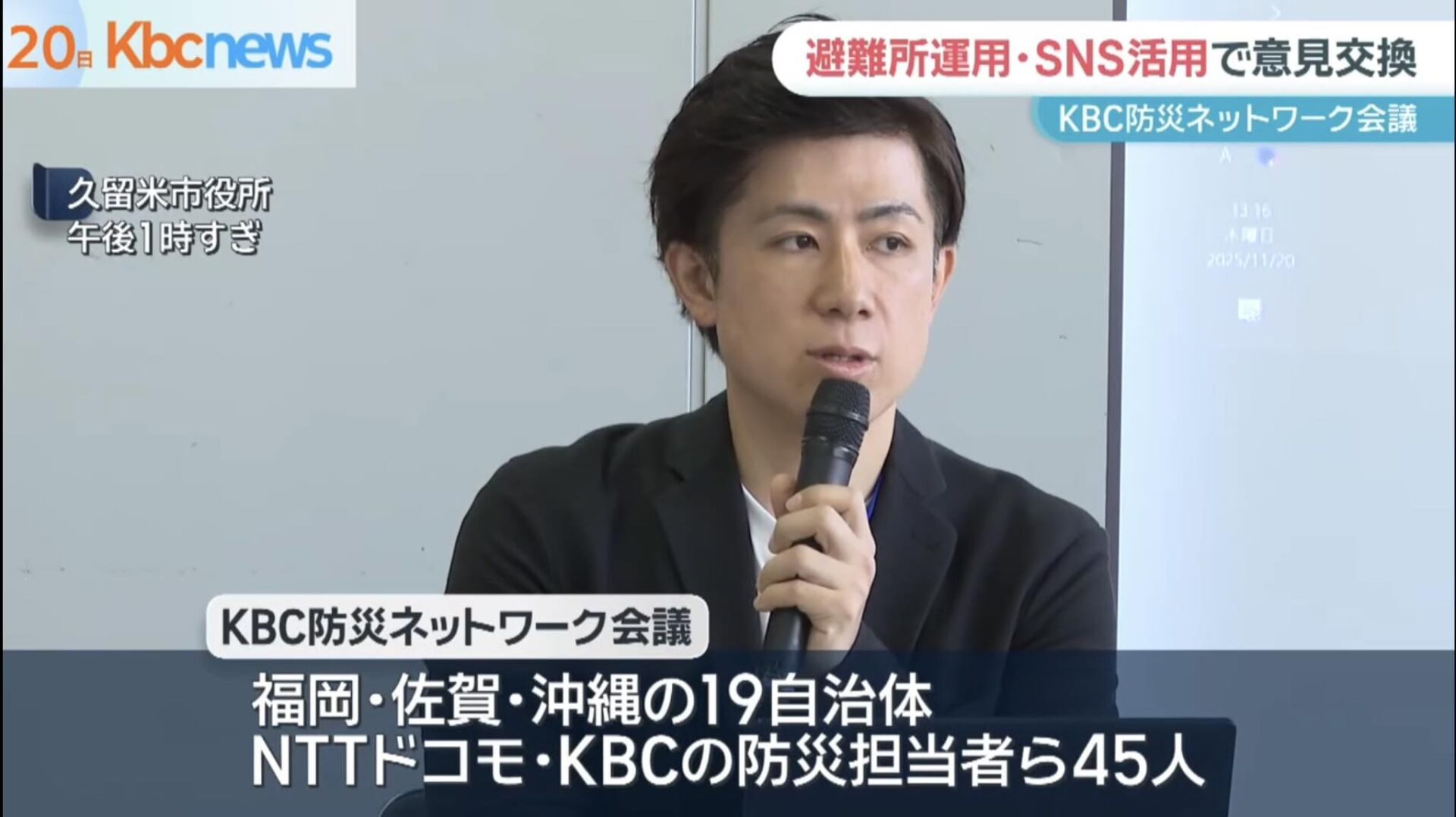
 SAKIGAKE JAPAN delivered a keynote presentation at the KBC Disaster Prevention Network Conference held in Kurume City, Fukuoka Prefecture. The lecture focused on global disaster-management trends and their potential implementation in the Chikugo region.
The conference brought together 19 municipalities across Fukuoka, Saga, and Okinawa, serving as a valuable platform to discuss the “current state” and “future direction” of regional disaster preparedness. With the increasing severity of disasters—such as the recent Northern Kyushu heavy rains and the Noto Peninsula earthquake—updating local disaster management has become an urgent national issue.
Notably, opportunities for media organizations and municipalities to jointly discuss disaster resilience are rare nationwide, making this initiative both meaningful and forward-thinking.
▼Our CEO appears from 0:16–
1. About the KBC Disaster Prevention Network Conference — A New Collaborative Model Between Media and Municipalities
19 Municipalities Across Fukuoka, Saga, and Okinawa Gather
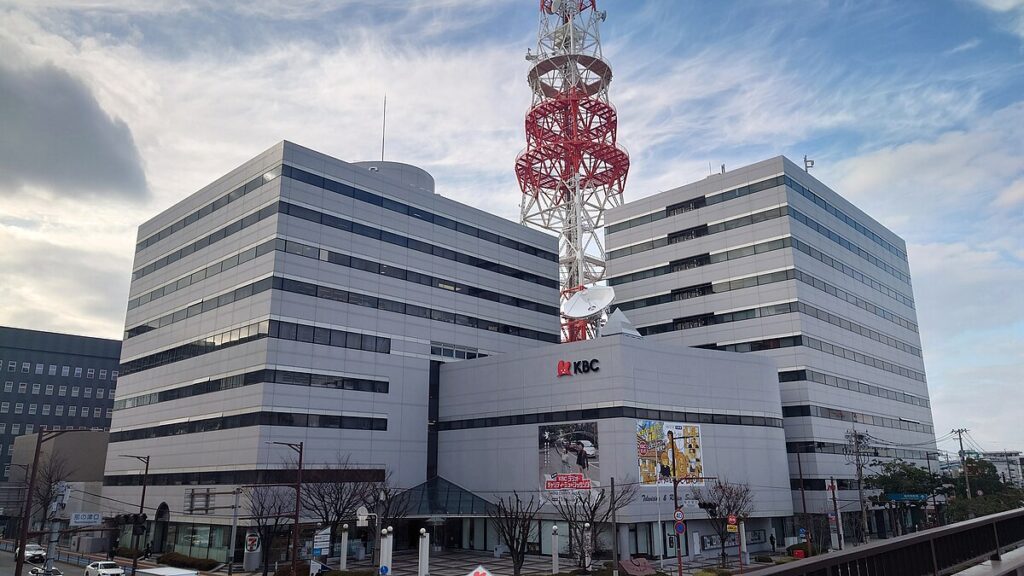
The KBC Disaster Prevention Network Conference is led by the regional broadcaster KBC, bringing together municipalities and relevant organizations to strengthen disaster preparedness across the region. Discussions covered disaster response, information-sharing mechanisms, and region-specific risk assessments.
It represents a rare collaboration between media and local government, a combination that can dramatically improve disaster communication and resident behavior during crises.
Media: Strength in transmitting information widely
Municipalities: Deep understanding of local conditions
https://ja.wikipedia.org/wiki/%E4%B9%9D%E5%B7%9E%E6%9C%9D%E6%97%A5%E6%94%BE%E9%80%81
2. Why Municipalities Now Need a “Global Perspective”
The lecture explored practical models from Italy, Taiwan, and the U.S. FEMA—countries and regions with proven disaster-management systems. Rather than merely presenting case studies, the aim was to extract transferable lessons that Japanese municipalities could apply immediately.
Three Key International Themes Highlighted
Italy — Community-Based Disaster Management & Standardized Procedures
A nationally unified system for supplies, personnel, and operational procedures enables consistent response regardless of the responding unit.
Taiwan — Digital Disaster Management & Operationalized Shelters
QR-based shelter registration, dashboards, Sphere-compliant standards, and a culture of designing shelters to be operational before the disaster occurs.
United States (FEMA) — Standardized Disaster Management via ICS
A nationwide command structure (NIMS/ICS) enables unified decision-making, centralized asset data, and extremely rapid initial response.
Why These Global Examples Are Relevant Now
Because Japan faces the same structural challenges as these countries.
Climate change has amplified storms, flooding, and landslides globally—especially in Kyushu, where disasters increasingly affect entire river basins.
Across leading disaster-preparedness nations, three trends have become standard:
- Data-driven operations — damage, resources, and field conditions are visualized
- Standardization — shelters, supplies, and procedures follow unified formats
- Network-based response — cooperation across basins, states, and sometimes borders
These approaches are essential today, when “experience-based disaster management” is no longer sufficient.
Lecture tailored for the Chikugo region
The Chikugo area—characterized by major rivers such as the Chikugo and Yabe Rivers—faces heightened risks of heavy rainfall and inland flooding due to its mixed landscape of rivers, farmland, and residential areas.
Slides shown during the lecture
3. What Global Best Practices Reveal : “Disaster Damage Can Be Reduced Through Systems”
In the past decade, global disaster management has rapidly evolved, establishing pillars of data, standardization, and networking. Countries that effectively reduce disaster impacts always possess frameworks with high reproducibility.
Examples
- Italy: Nationwide standardization of shelters, water supply, toilets, kitchens, and procedures enabled rapid deployment of over 5,000 specialists during the 2016 Central Italy earthquake.
- FEMA (U.S.): NIMS/ICS centralizes command, resource data, and logistics. The location of supplies and units is always known, ensuring fast initial response.
- Taiwan: Sphere-standard shelters, individual booths, QR check-in, dashboards, and trained operational teams have transformed shelters into predictable and manageable systems.
Common Principles in Leading Disaster-Preparedness Nations
- Standardization of supplies, personnel, and procedures
- Unified command and integrated data (FEMA model)
- Standardized and digitized shelter management (Taiwan model)
- Operational structures that assume inter-regional cooperation
- Systems that allow “any team to operate effectively anywhere”
All are grounded in the idea that resilience is created by systems, not by individual effort.
4. Applicability to the Chikugo Region — A “River Basin–Wide” Approach
The Chikugo region, while agriculturally rich, has inherent water-related vulnerabilities. Its proximity of rivers, farmland, and residential areas means even moderate rainfall can lead to basin-wide flooding. Many challenges cannot be solved by individual municipalities acting alone.
During the lecture, a data-driven basin model was introduced—integrating inundation simulation, landslide risk, inland flooding, evacuation behavior, and lifeline impacts. This unified “map” enables upstream and downstream areas to operate with a shared understanding of risks.
Standardization aligns well with the region’s needs and is feasible even for smaller municipalities. Areas such as shelter management, toilet standards, stockpile systems, and logistics coordination can all be improved with modest steps.

https://www.bousaihaku.com/otherdisaster/14072/
5. The Value of Media and Municipalities Discussing the Future Together
Media and local governments are naturally complementary:
- Media excels at rapid, wide-reaching information dissemination
- Municipalities possess hyperlocal expertise and context
In an era of increasingly complex, cascading disasters, aligning these two roles is essential. This conference provided an important model not only for the Chikugo region but for municipalities nationwide.
6. The Role of SAKIGAKE JAPAN Moving Forward
SAKIGAKE JAPAN aims to serve as a bridge between data and on-the-ground practice, supporting the development of basin-wide disaster-preparedness infrastructure. Our mission is not merely to introduce technology, but to help create a shared language for disaster resilience across communities.
Key Contribution Areas
- Implementation of data-driven regional models
- Localization of Italian, FEMA, and Taiwanese standardization best practices
- Deployment of advanced technologies (photoluminescent signs, off-grid refrigeration, HelioPortable, etc.)
- Disaster-preparedness education and workforce development
- Joint disaster specialist program with The University of Tokyo
We remain committed to translating global knowledge into practical local action and serving as a partner that combines scientific insight with real-world implementation.
Product Information & Contact
▶ Product Lineup
https://sakigakejp.com/en/sales/
▶ Contact Form
https://sakigakejp.com/en/contact-en/